Week 1
Global Nexus
Active Regions
AfricaNode 01
CaribbeanNode 02
United StatesNode 03
United KingdomNode 04
EuropeNode 05
WOCPSCN · Est. 2009Diplomatic Modernism
Gandhi Mandela Academy Leadership Curriculum
The Intersection of Gandhi's Non-Violence Practice in the MLK Jr. Civil Rights Movement
Summer Academic Program · 2027
Presented by
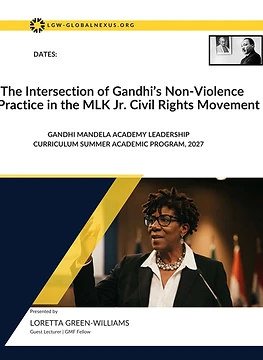
Loretta Green-Williams
Guest Lecturer · GMF Fellow
About LGW
A visionary global strategist in women's leadership and sustainability.
Loretta Green-Williams is a visionary global strategist in women's leadership and sustainability, a social entrepreneur, and an international connector advancing opportunities for women and girls across Africa, the Caribbean, the United States, the United Kingdom, and Europe.
As Founder and Chief Executive Director of Women of Concern Professionals & Strategic Conscious Networking, Inc. (WOCPSCN), she has built an international platform that unites professional women, emerging leaders, youth, organizations, and strategic partners around four principles of practice. Her leadership is grounded in the belief that sustainable change occurs when women and young people have access, exposure, participation, education, and meaningful pathways to leadership.
After enduring personal tragedy, she transformed grief into a call to action — deepening her resolve to advocate for women, families, and marginalized communities. This resilience fuels an empathic leadership style in which personal healing, community advancement, and professional development intersect. Her work as a human rights advocate and ordained-licensed minister reflects a dedication to service, moral clarity, and social justice.
Course Overview
This intensive summer academic program explores how Mahatma Gandhi's philosophy of Satyagraha (truth force) and non-violent resistance crossed continents to shape the American Civil Rights Movement under the leadership of Dr. Martin Luther King Jr. Grounded in the ethical framework of the Gandhi Mandela Academy, the course moves beyond historical analysis to examine leadership as an inner discipline. Students analyze how moral clarity, personal accountability, and community-driven action can dismantle systemic injustice.
Core Foundational Pillars Integration
Integrity
Cultivating moral alignment between personal beliefs and public actions, mirroring Gandhi's "experiments with truth" and Dr. King's "Letter from Birmingham Jail."
Responsibility
Accepting active ownership for societal well-being and acknowledging individual duty in the face of structural oppression or institutional apathy.
Service (Seva)
Prioritizing community upliftment and collective liberation over individual advancement as the ultimate measure of effective leadership.
Weekly Course Outline
Eight weeks from philosophical roots to capstone.
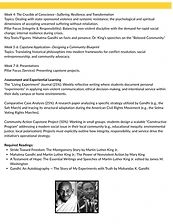
Week 2
The Transatlantic Bridge — From India to Montgomery
Week 3
Strategy, Tactics, and Moral Architecture of Movements
Week 4
The Crucible of Conscience — Suffering, Resilience, and Transformation
Weeks 5–6
Capstone Application — Designing a Community Blueprint
Weeks 7–8
Presentations
Assessment & Experiential Learning
25%
The "Living Experiment" Journal
Weekly reflective writing where students document personal "experiments" in applying non-violent communication, ethical decision-making, and intentional service within their daily campus or home environments.
25%
Comparative Case Analysis
A research paper analyzing a specific strategy utilized by Gandhi (e.g., the Salt March) and tracing its structural adaptation during the American Civil Rights Movement (e.g., the Selma Voting Rights Marches).
50%
Community Action Capstone Project
Working in small groups, students design a scalable "Constructive Program" addressing a modern social issue in their local community (e.g., educational inequity, environmental justice, local polarization). Projects must explicitly outline how integrity, responsibility, and service drive the initiative's operational strategy.


New Course Offering
Mapping Self, Spirit, and Struggle: From Feminism to Womanism in the African Diaspora
Course Level
Undergraduate / Community Seminar
Duration
6 Weeks
Format
Seminar · Discussion-Based
Course Overview
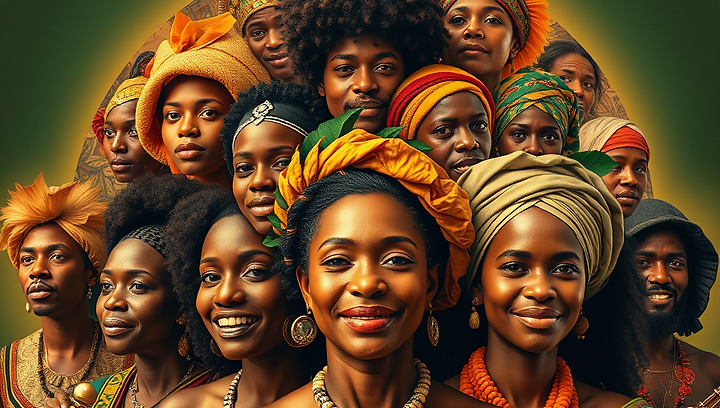
This intensive 6-week course examines the intellectual, political, and cultural shifts from mainstream Western feminism to Black feminism and Womanism. Students will explore how women of the African diaspora (across the United States, the Caribbean, Latin America, and Europe) have navigated, critiqued, and expanded liberation movements to address the interlocking matrix of race, gender, class, and sexuality.